Palazzo Rucellai: Alberti's Renaissance Façade in Florence
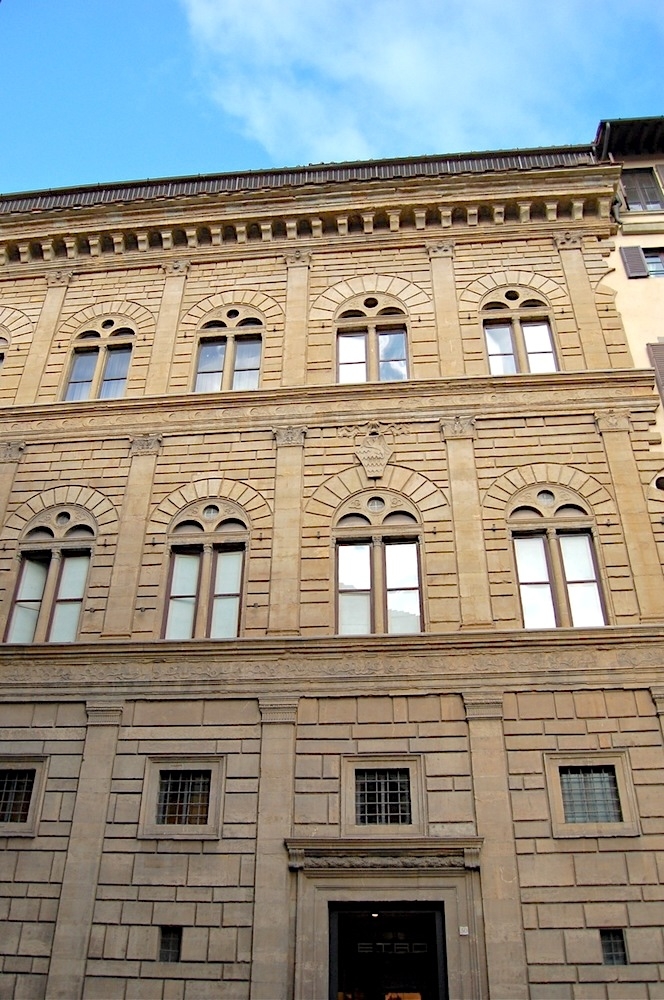
Palazzo Rucellai, on Via della Vigna Nuova, has one of the most influential house fronts of the early Renaissance. Leon Battista Alberti designed it for the merchant Giovanni di Paolo Rucellai in the mid-1400s, and Bernardo Rossellino built it. Instead of the heavy, fortress-like stone of earlier palaces such as the Palazzo Medici Riccardi, Alberti laid a grid of classical pilasters and cornices over the wall, borrowed straight from ancient Rome. The interior is not a museum, but the façade, the family loggia across the street and the Alberti chapel behind the palazzo make a rewarding half hour.
Alberti, Rossellino and who really designed it
Giovanni Rucellai (1403-1481) was a wool merchant and banker, one of the richest men in Florence, and he spent his fortune on building. From 1446 he bought up houses along Via della Vigna Nuova and Via dei Palchetti, and eight older dwellings were eventually joined into a single palazzo arranged around a central courtyard.
Most scholars credit the façade to Alberti, the humanist and author of the architectural treatise De re aedificatoria, who also worked for Rucellai at Santa Maria Novella and San Pancrazio. Bernardo Rossellino's role in remodeling the interior, building the entrance passage and creating the courtyard is not disputed. The façade is less certain. Its traditional date is 1446-1451, but tax records suggest part of it went up after 1461, and the earliest 16th-century writers credited Rossellino with the model. A minority of historians therefore argue that Rossellino designed it himself. He certainly used an almost identical front for Palazzo Piccolomini in Pienza, built for Pope Pius II in 1459-1462.
How to read the façade
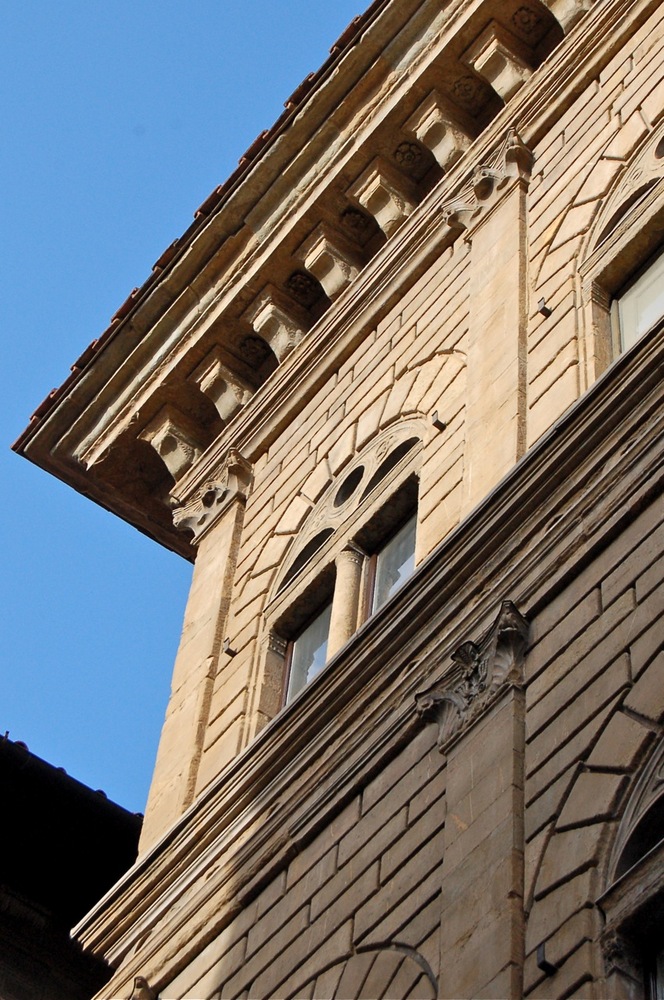
Stand in the little triangular Piazza dei Rucellai opposite the palazzo and the logic is easy to see. Flat pilasters and horizontal entablatures divide the front into a grid of bays three stories high, and each story uses a different classical order, stacked the way they are on the Colosseum. The stone is cut with shallow, regular channels rather than the rough, bulging blocks of the Medici palace, so the wall reads as a smooth background for the architecture. A deep projecting cornice caps the top.
Look low and you will see the long stone bench running along the base, a standard feature of 15th-century Florentine palaces that passers-by still sit on. Behind it, the plinth is carved in a diamond net pattern copied from Roman opus reticulatum masonry. The frieze above the ground floor carries the family emblems: the Rucellai sail filled with wind, and the Medici diamond ring with feathers, a reference to the 1466 marriage of Giovanni's son Bernardo to Nannina de' Medici, granddaughter of Cosimo the Elder and sister of Lorenzo the Magnificent.
The unfinished right-hand edge
The façade went up in stages: first five bays with a central door over the original family houses, then two more bays with a second door. The right-hand end stops abruptly, its stones left jagged as if the masons might come back on Monday. Rucellai never managed to buy the next house in the row, so the front stayed at seven bays, one short of the eight it was planned to have. The missing bay would have carried a third door.
The Loggia Rucellai
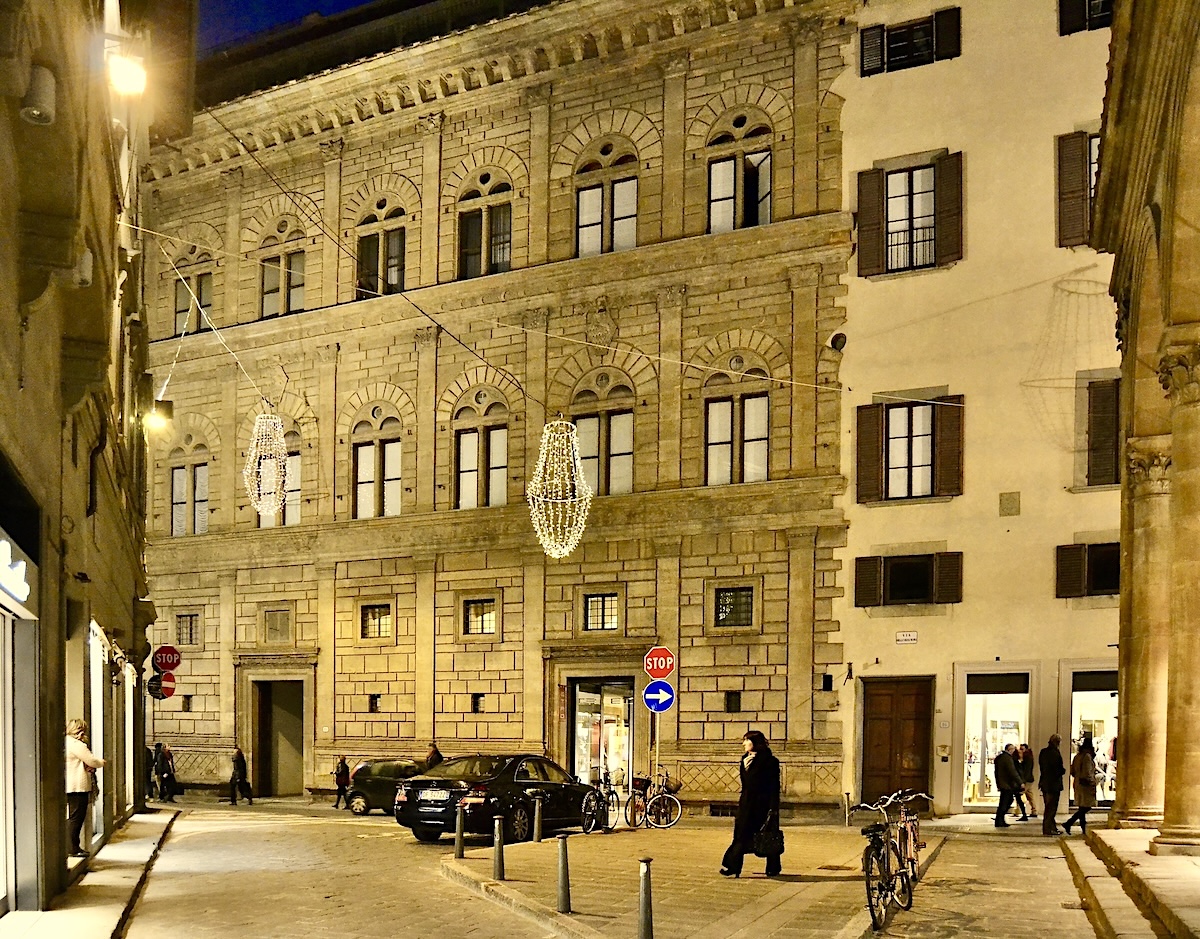
Across the piazza, set at right angles to the palazzo, is the family loggia - three round arches on columns, with the wind-filled sail repeated along the frieze. It was built in the 1460s and is often attributed to Alberti, though the documents do not settle it. The family used it for weddings and ceremonies, including the 1466 Rucellai-Medici wedding, until 1677. The arches are now glazed in and the space is a shop, but the architecture is fully visible from the street.
Inside: ISI Florence
Palazzo Rucellai is privately owned and has no public opening hours. The piano nobile is home to ISI Florence, the International Studies Institute (formerly the Institute at Palazzo Rucellai), an American study abroad center with programs in art history, architecture, studio art, Italian studies and the liberal arts. Those rooms were redecorated in 1740 for the wedding of Giuseppe Rucellai and Teresa de' Pazzi, and their vaulted ceilings are frescoed with mythological figures and motifs. ISI arranges tours for prospective students, parents, faculty and university representatives who contact it in advance, but it does not run visits for tourists. The Rucellai family still keeps a residence in the building.
Giovanni Rucellai's Alberti trail
Rucellai hired Alberti for two more projects that are a short walk from the palazzo, and both are worth adding to the visit.
The Rucellai Chapel and Tempietto. Directly behind the palazzo, in the former church of San Pancrazio, Alberti designed the Tempietto del Santo Sepolcro (1467), a small marble shrine modeled on the Holy Sepulchre in Jerusalem and inlaid with 30 different panels of naturalistic and symbolic designs. Giovanni Rucellai is buried there. The rest of the church was deconsecrated in the early 1800s and now houses the Museo Marino Marini, dedicated to the 20th-century sculptor; the chapel, still consecrated, is entered through the museum on Piazza San Pancrazio. The museum currently opens Saturday through Monday, 10 a.m. to 7 p.m., and one €10 ticket covers the museum and the chapel. The chapel admits only small groups at a time.
Santa Maria Novella. Rucellai also paid for Alberti to complete the marble façade of the basilica of Santa Maria Novella, finished in 1470. His Latin name, Iohannes Oricellarius, runs across the frieze with the date, and the Rucellai sail appears again in the façade's decoration.
Visiting tips
- The façade, the loggia and the bench are all outdoors and free, and can be seen at any hour.
- For the full view of the front, stand under or beside the loggia in Piazza dei Rucellai; the street is too narrow to take it in from the opposite pavement elsewhere.
- The palazzo is a two-minute walk west of Via de' Tornabuoni and Palazzo Strozzi, which makes it an easy stop between shopping and Piazza Santa Maria Novella.
- To see how radical Alberti's design was, compare it with the rusticated front of the Palazzo Medici Riccardi, about a 15-minute walk away near San Lorenzo.
- For lunch or dinner nearby, see our picks for restaurants in the Santa Maria Novella area, or browse the other palazzi of Florence.
- The building is a working school and a private home. Unless you have arranged a visit with ISI, admire it from the street.
Frequently Asked Questions
Who designed Palazzo Rucellai?
Most scholars credit Leon Battista Alberti with the design of the façade, made for the merchant Giovanni di Paolo Rucellai in the mid-1400s. Bernardo Rossellino built it and is accepted as the author of the interior remodeling, the entrance passage and the courtyard. A minority of historians argue that Rossellino also designed the façade.
Can you go inside Palazzo Rucellai?
Not as a tourist. The palazzo is privately owned and is not a museum. Its piano nobile houses ISI Florence, an American study abroad institute, which arranges tours for prospective students, parents, faculty and university representatives who contact it in advance.
Why does the façade of Palazzo Rucellai look unfinished?
The façade was built in stages, first five bays and then two more. Giovanni Rucellai never acquired the next house in the row, so the front stopped at seven bays instead of the eight planned, and its right-hand end was left with jagged, uncut stones.
What is the Loggia Rucellai?
It is the Rucellai family loggia, three round arches facing the palazzo across the small Piazza dei Rucellai. Built in the 1460s, it hosted family weddings and ceremonies, including the 1466 marriage of Bernardo Rucellai and Nannina de' Medici. The arches are now glazed in and the space is a shop.
Where can I see other works by Alberti near Palazzo Rucellai?
Behind the palazzo, the Rucellai Chapel in the former church of San Pancrazio holds Alberti's Tempietto del Santo Sepolcro, entered through the Museo Marino Marini. A short walk north, Alberti completed the marble façade of Santa Maria Novella for Giovanni Rucellai in 1470.
Comments:
By Anthony Finta, last updated:
What's New?
-

German Christmas Market in Piazza Santa Croce
Oct 30, 2026
-
Palazzo Vecchio Museum: Hours, Tickets, What to See
Sep 29, 2026
-
Sillico and the Garfangana
Sep 28, 2026