Piazza San Marco
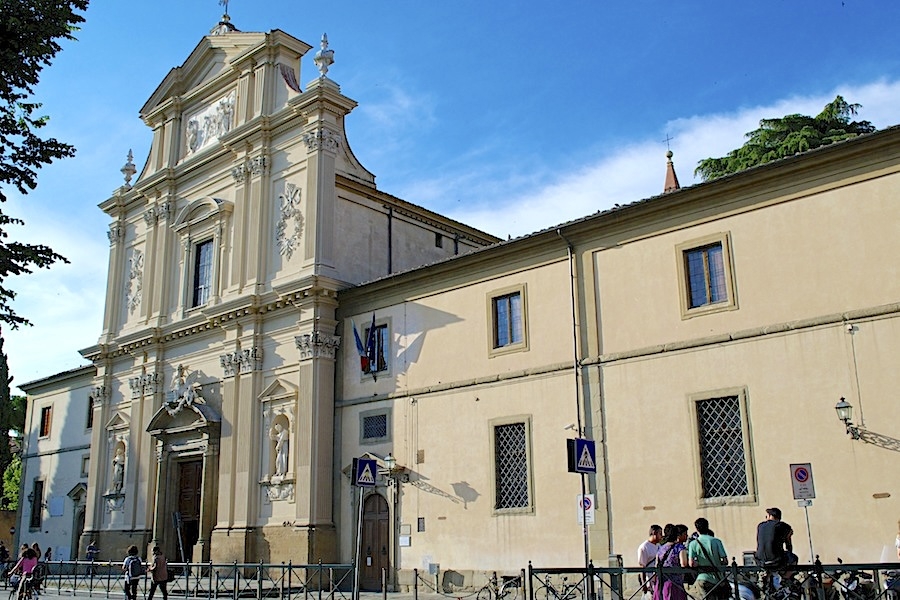
Historical Development and Cultural Significance in Florence
Piazza San Marco occupies a significant position in Florence's northern quarter, representing a notable example of Renaissance urban planning integrated with religious and educational institutions. The square's development reflects broader patterns of Medici patronage and Dominican influence in 15th-century Florence.
Historical Origins and Architectural Commission
The piazza was established in the first half of the 15th century through the patronage of Cosimo de' Medici (1389-1464), known as Cosimo the Elder. In 1436, Cosimo commissioned the architect Michelozzo di Bartolomeo (1396-1472) to design and construct a church and monastery complex for the Dominican Order. The project facilitated the relocation of Dominican monks from their existing convent of San Domenico in Fiesole to this new Florentine location.
Michelozzo's architectural work on San Marco represents an important transition from Gothic to Renaissance style, featuring his characteristic use of clear geometric forms and the innovative design of the monastery's cloister. The project was completed around 1443 and became one of the first examples of Renaissance monastery architecture.
The Church and Museum of San Marco
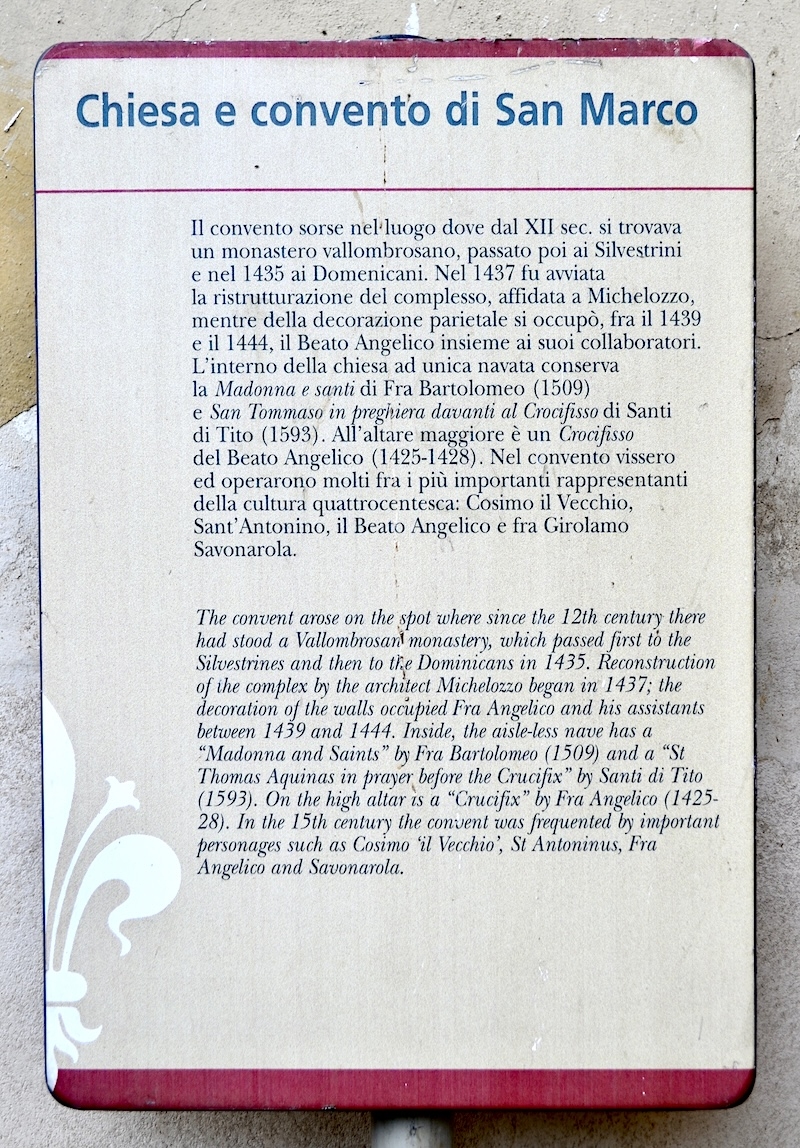
The Church of San Marco and its adjoining monastery occupy the northern side of the piazza. The monastery was consecrated on Epiphany, January 6, 1443. The complex now largely functions as the Museum of San Marco (Museo di San Marco), which opened to the public in 1869.
The museum is particularly significant for its collection of works by Fra Angelico (c. 1395-1455), born Guido di Pietro, who was himself a Dominican friar residing in the monastery. Between approximately 1438 and 1445, Fra Angelico and his workshop painted frescoes in the chapter house, corridors, and individual monks' cells. Notable works include the "Annunciation" at the top of the dormitory stairs, the "Crucifixion with Saints" in the chapter house, and approximately fifty cell frescoes intended for private devotional meditation.
The monastery also served as the residence of Girolamo Savonarola (1452-1498), the Dominican friar and reformist preacher whose sermons against corruption and calls for religious renewal dominated Florentine politics in the 1490s. Savonarola served as prior of San Marco from 1491 until his arrest in 1498. His cells and several artifacts related to his life and execution are preserved in the museum.
Surrounding Institutions and Monuments
The Accademia di Belle Arti di Firenze (Academy of Fine Arts) is situated at the southeastern corner of the piazza, where Via Ricasoli enters the square. Founded in 1563 as the Accademia delle Arti del Disegno by Giorgio Vasari under the patronage of Cosimo I de' Medici, it was reorganized into its current form in 1784 under Grand Duke Pietro Leopoldo. The academy continues to function as an institution of higher artistic education.
The center of the piazza features an equestrian monument to General Manfredo Fanti (1806-1865), erected in 1873. Fanti was a military commander who played a significant role in the Wars of Italian Independence and later served as Minister of War in the newly unified Italian government. The monument was designed by Pio Fedi.
The Monastery of St. Catherine occupies another corner of the square, contributing to the concentration of religious institutions in this area.
The Farmacia di San Marco, located near Via Cavour, has particular historical interest. Operated by the Dominican friars from the early years of the monastery, it reflects the order's scholarly engagement with botanical medicine and pharmaceutical preparation. The Dominicans maintained extensive herb gardens and developed considerable expertise in creating medicinal compounds. The original pharmaceutical insignia remains visible on the building's exterior, providing material evidence of this pharmaceutical tradition that continued for several centuries.
Contemporary Function and Urban Context
The piazza has been re-landscaped in recent years to accommodate its function as a major transportation node. Multiple bus lines operated by Autolinee Toscane (AT) serve the square, and it functions as both a terminus and transfer point for several routes. Bus lines including 6, 11, 12, 17, 23, 31, and 32, as well as the C1 minibus line, stop at or near the piazza. A taxi stand provides additional transportation options.
Most significantly, on January 25, 2025, Florence's T2 tramway line (T2 Vespucci) was extended from Santa Maria Novella railway station to reach Piazza San Marco. The tram now connects the piazza directly to the main train station, Fortezza da Basso, Piazza della Libertà, and Florence's Peretola Airport, representing a major enhancement to the square's accessibility and its role in the city's public transportation network.
The southern edge of the piazza features various commercial establishments, including the Gran Caffè San Marco. Historically, this café has served as an informal gathering place for academics, artists, and students from nearby institutions, continuing a tradition of intellectual exchange characteristic of university quarters in Italian cities.
Scholarly and Artistic Significance
Piazza San Marco's importance extends beyond its individual monuments to its role in the broader history of Renaissance Florence. The square exemplifies the integration of religious patronage, artistic production, and urban development characteristic of the period. The San Marco complex demonstrates how Medici support for Dominican reform movements materialized in architectural and artistic commissions that shaped both the physical and intellectual landscape of the city.
The preservation of Fra Angelico's frescoes in situ provides scholars and visitors with rare insight into the devotional and aesthetic practices of Renaissance monasticism. The connection to Savonarola adds a layer of political and religious history, linking the square to some of the most dramatic moments in late 15th-century Florentine history.
For those studying Renaissance art, architecture, or religious history, Piazza San Marco and its associated institutions remain essential sites that offer substantial primary evidence of the period's cultural production and social organization.
Hotels and places to stay around Piazza San Marco:
Comments:
By Anthony Finta, last updated:
What's New?
-
Palazzo Vecchio Museum: Hours, Tickets, What to See
Sep 29, 2026
-
Sillico and the Garfangana
Sep 28, 2026
-

Tuscan Horticultural Society
Sep 20, 2026

-

Badia Fiorentina
Aug 31, 2026
-

Festa della Rificolona
Aug 30, 2026
-

Vinny's Florence Food Walking Tour
Aug 27, 2026