Florence American Cemetery and Memorial
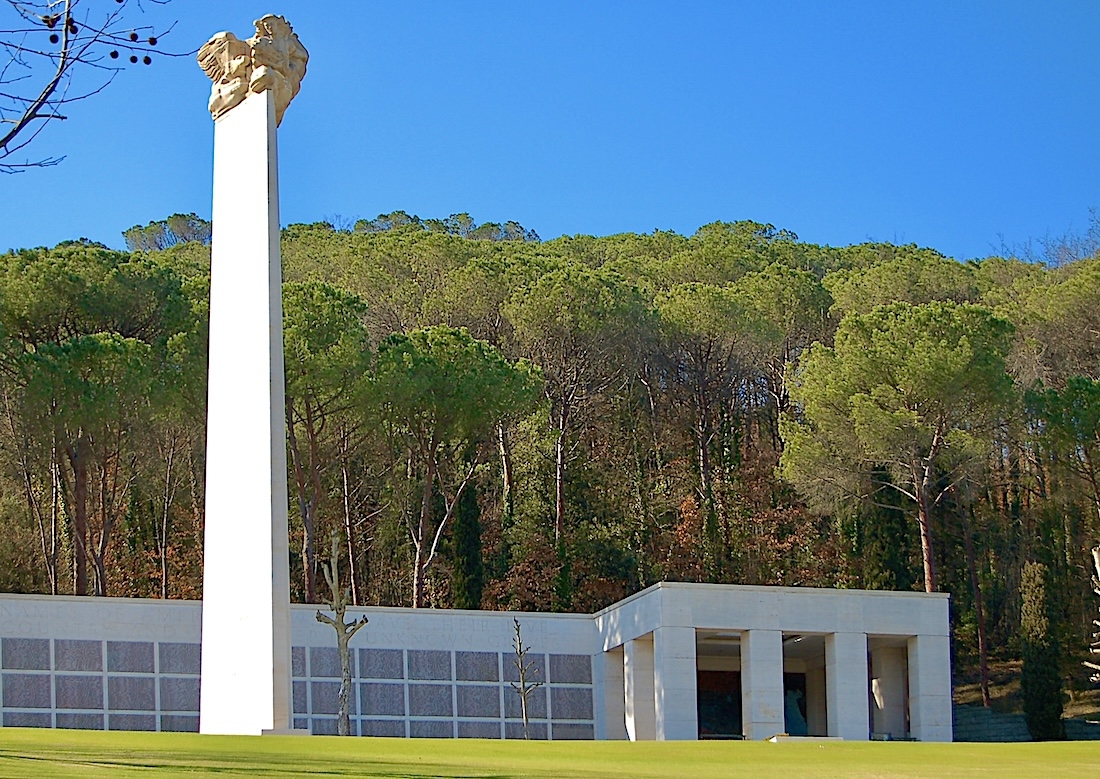
About seven and a half miles south of Florence, tucked among the wooded hills of the Greve River valley in the municipality of Tavarnuzze, lies one of the most quietly moving places in all of Tuscany — a place most tourists never visit, but every visitor to Florence arguably should. The Florence American Cemetery and Memorial covers roughly 70 acres, framed by wooded hills that rise several hundred feet along its western perimeter. Here, under Tuscan skies, rest more than four thousand Americans who gave their lives to liberate Italy from fascism.
Historical Context: The Italian Campaign
To understand the cemetery, you need to understand what happened on the ground in Italy during the Second World War. After the Allied landings in Sicily in 1943, the campaign to push northward through the Italian peninsula proved brutally slow. The terrain — mountains, river crossings, narrow valleys — gave the defending Germans every advantage.
The cemetery covers what is called the Northern Campaign, encompassing all battles from the Liberation of Rome on June 5, 1944, through the brutal fighting in the Apennine Mountains until the final German surrender in northern Italy on May 2, 1945. The area that now hosts the cemetery was liberated by the South African 6th Armoured Division on August 3, 1944, before falling under the operational zone of the U.S. Fifth Army.
Why Here?
After the war ended, the many temporary battlefield cemeteries scattered across central and northern Italy were deemed unsuitable as permanent resting places. The site near the Greve River was chosen as a permanent cemetery because of its centralized location relative to those 20 temporary cemeteries. The Florence American Cemetery is one of only fourteen permanent American World War II military cemetery memorials outside the United States — the only other one in Italy is at Anzio.
Design and Architecture
The cemetery was designed by the renowned New York architecture firm McKim, Mead & White, while landscape architects Clarke and Rapuano designed the grounds. It was formally dedicated in 1960.
The layout is both solemn and stunning. Between the two entrance buildings, a bridge leads across the Greve River to the burial area, where headstones are arrayed in symmetrical curved rows across the hillside. A long straight avenue divides the grounds into two large green meadows. Among the markers, 76 are Stars of David and 4,322 are Latin crosses — a quiet reminder of the diversity of those who served.
The Memorial

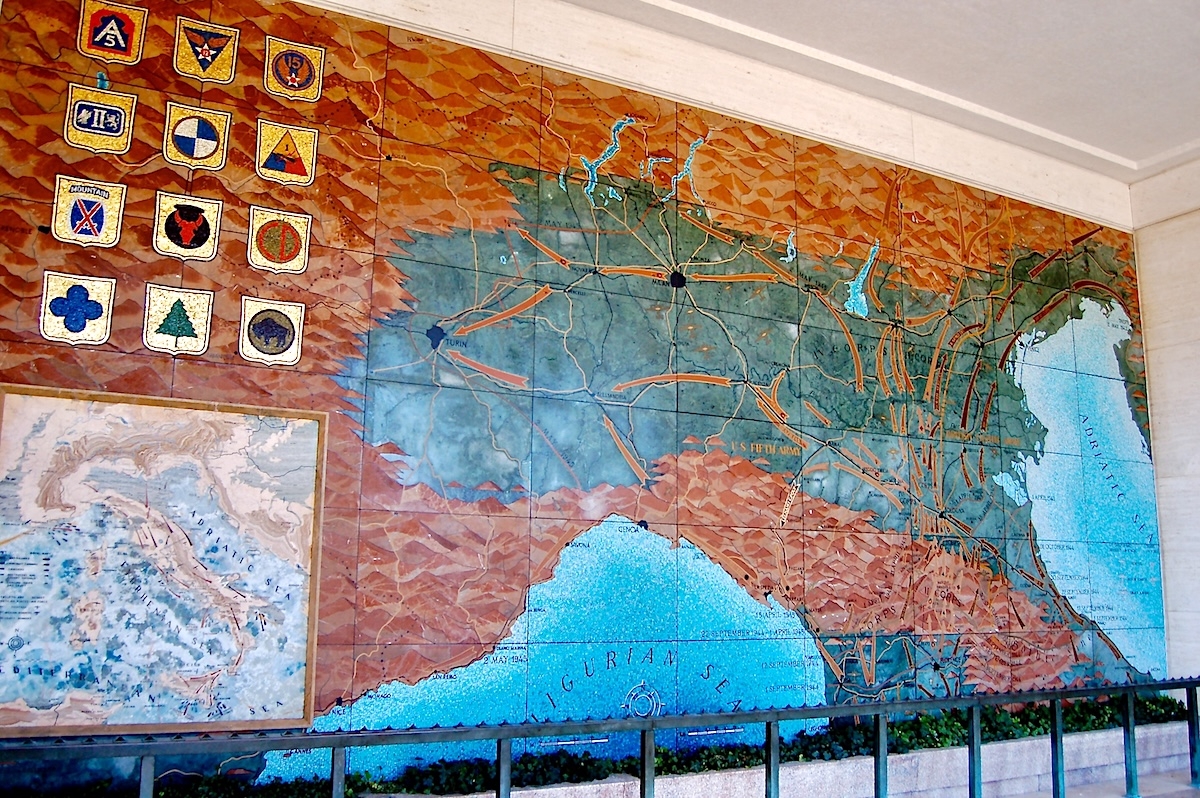
At the center stands a tall pylon surmounted by a sculpture representing the Spirit of Peace. The surrounding walls bear not only the names of the missing, but also the military insignia of the various branches and specialties: Infantry, Army Air Corps, Medical Corps, Corps of Engineers, Field Artillery, Signal Corps, and many more.
The atrium at the south end serves as a forecourt to the chapel, decorated with marble and mosaic. On the chapel door, a carved figure represents “The Spirit of American Youth,” alongside an American Eagle. The north atrium contains marble operations maps recording the achievements of American armed forces throughout the region.
Medals of Honor
Among those buried and memorialized here are recipients of the nation’s highest military decoration. Two Medal of Honor recipients — Roy W. Harmon and George D. Keathley — are interred in the cemetery. A third, Lt. Col. Addison Baker of the Army Air Corps, is memorialized here by cenotaph. Baker earned his medal during a legendary low-level bombing raid on the oil refineries at Ploșeşti, Romania in August 1943, and has no known grave.
The Human Scale
The average age of the service members buried here was just 20 years old — young men who left their homes and loved ones to fight fascism and who made the ultimate sacrifice. Walking among the rows of white markers, that statistic becomes something more than a number. There are 4,392 individual stories here, each one a life interrupted.
The cemetery is impeccably maintained by the American Battle Monuments Commission, and it is open to the public 363 days a year, closing only on Christmas Day and New Year’s Day. When open, a staff member is always on duty to answer questions and escort relatives to gravesites. Visitors are also welcome to place flowers at individual gravesites.
Getting There from Florence
The cemetery is far more accessible than most visitors realize. By bus, the Autolinee Toscane lines 365A, 368A, or 370A all stop right at the cemetery gate along the Via Cassia — tell the driver you want Cimitero degli Americani. The ride from central Florence takes roughly 25 minutes. By car, take the Certosa exit off the A1 autostrada and head south on the Via Cassia for about two miles. Taxis are also readily available from the Santa Maria Novella train station.
The cemetery is open daily from 9 a.m. to 5 p.m. (except December 25 and January 1). Admission is free.
A Place Worth Visiting
In a city overflowing with Renaissance art and ancient beauty, the Florence American Cemetery offers something different — a reminder that the freedom to wander those famous streets and piazze came at an enormous cost, paid in part by young Americans buried beneath Tuscan soil, far from home. It is a powerful, affecting experience, and well worth the short journey south from the city.
Florence American Cemetery and Memorial
Via Cassia S.N., 50023 Tavarnuzze (Firenze), Impruneta
Tel: +39 055 202 0020
Open daily 9:00 a.m. – 5:00 p.m. | Closed December 25 & January 1
Administered by the American Battle Monuments Commission
Comments:
By Anthony Finta, last updated:
What's New?
-
Palazzo Vecchio Museum: Hours, Tickets, What to See
Sep 29, 2026
-
Sillico and the Garfangana
Sep 28, 2026
-

Tuscan Horticultural Society
Sep 20, 2026

-

Badia Fiorentina
Aug 31, 2026
-

Festa della Rificolona
Aug 30, 2026
-

Vinny's Florence Food Walking Tour
Aug 27, 2026