Badia Fiorentina


Nestled just off Piazza San Firenze, the Badia Fiorentina (usually considered one of oldest churches in Florence) dates its origins back to 978. Around the corner from Palazzo Vecchio and the Uffizi, directly across via del Proconsolo from the Bargello, the abbey's unassuming entryways (one on via del Proconsolo, and one on via Dante Alighieri) "hide" the church from the street (the part of the church visible from via del Proconsolo has no windows and a row of retail stores at street level - a longstanding leather goods shop is one of them). Hidden inside you will find: a Gothic interior, a Renaissance altarpiece, and a cloister most visitors never see. Its slender campanile is one of the tallest and most recognizable bell towers on the Florentine skyline. The Badia Fiorentina is truly a hidden gem, right in the center of Florence!
History
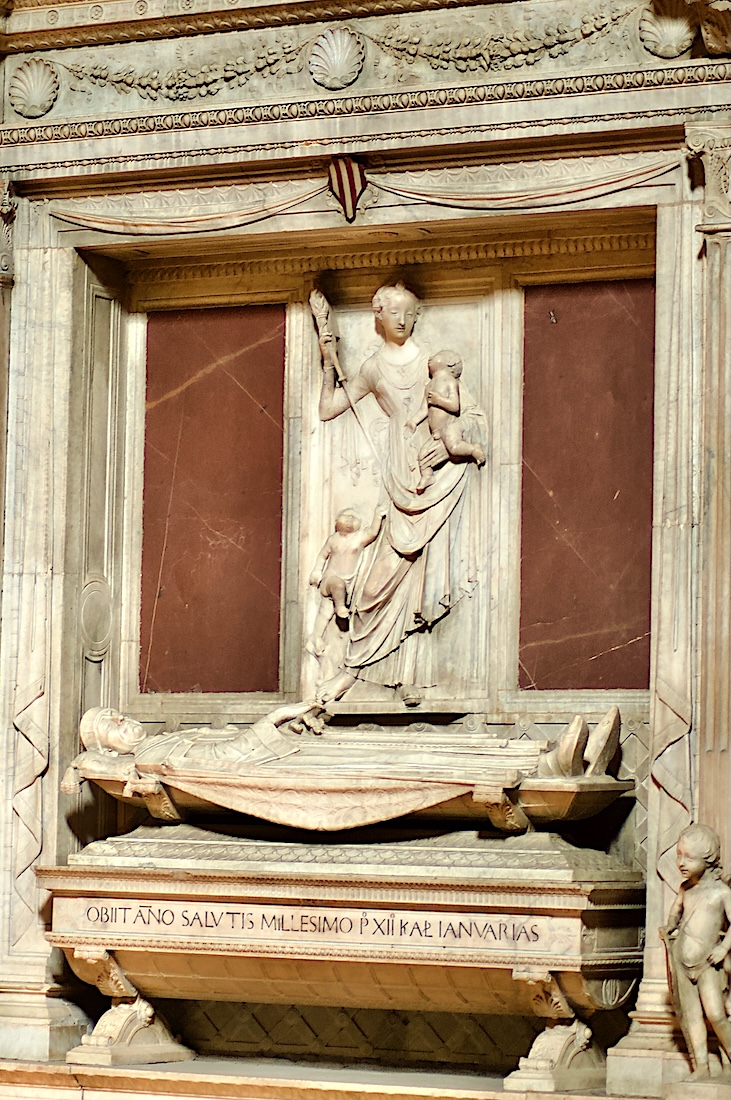
The Badia was founded in 978 by Willa, Countess of Tuscany, who dedicated it to the Virgin Mary in memory of her husband, Hubert. Willa's son Ugo, who became Margrave of Tuscany, expanded the abbey's holdings and endowments. Ugo is still honored every December 21 with a solemn Mass at the Badia - a tradition maintained for roughly a thousand years and attended, to this day, by the sitting president of the Florence city council carrying the city's ceremonial gonfalone. Dante Alighieri praised Ugo as the "great Baron" in the Paradiso, and Ugo's marble tomb, carved by Mino da Fiesole, still stands inside the church.
The Badia also holds a place in Florentine literary lore as the traditional site where Dante first saw Beatrice Portinari during Mass - a legend that has never been documented but has attached itself to the church for centuries. In 1373, Giovanni Boccaccio delivered public readings of the Divine Comedy inside the Badia, making it, briefly, one of the intellectual centers of the city.
Architecture
The original Romanesque abbey faced west, with three apses to the east, set at the edge of Florence's earliest city walls. In 1285, Arnolfo di Cambio - the architect behind Palazzo Vecchio and the Duomo - was commissioned to rebuild the church in the Gothic style, a project that took roughly three decades and reversed the building's orientation so the apse faced east. Part of that Gothic structure was deliberately demolished in 1307 as punishment against the monks for refusing to pay a tax; it was rebuilt by Giovanni Villani, who combined Romanesque lower work with Gothic upper elements and completed the slim campanile between 1310 and 1330. In 1627 the church was reworked again, this time in Baroque style on a Greek Cross plan, under Abbot Serafino Casolani and architect Matteo Segaloni. The monastery was suppressed in 1810, and the surrounding complex was carved up into houses, shops, offices, and storerooms - a fate common to Florentine religious institutions under Napoleonic-era secularization.
Art
The church's best-known work is Filippino Lippi's Apparition of the Virgin to St. Bernard, painted between 1482 and 1486 for a different chapel entirely and moved to the Badia in 1530. The altarpiece is known for its Flemish-influenced color and its unusually grounded, everyday treatment of a mystical scene - including a demon biting its own chains behind St. Bernard, and a scroll bearing Epictetus's Latin phrase sustine et abstine ("bear and forbear").
Mino da Fiesole's sculpture is the other major draw: his 1481 marble Tomb of Ugo of Tuscany is one of his most significant works, combining marble and porphyry and topped by a personification of Charity. His Tomb of Bernardo Giugni (1466-69) and the Neroni Dossal are also here. Additional works include Giorgio Vasari's Assumption of the Virgin Mary and Saints (1568), a pipe organ dating to 1558, and 18th-century apse murals by Giovanni Domenico Ferretti. Giotto's Badia Polyptych once hung here as well - it now lives in the Uffizi.
Cloister of the Oranges
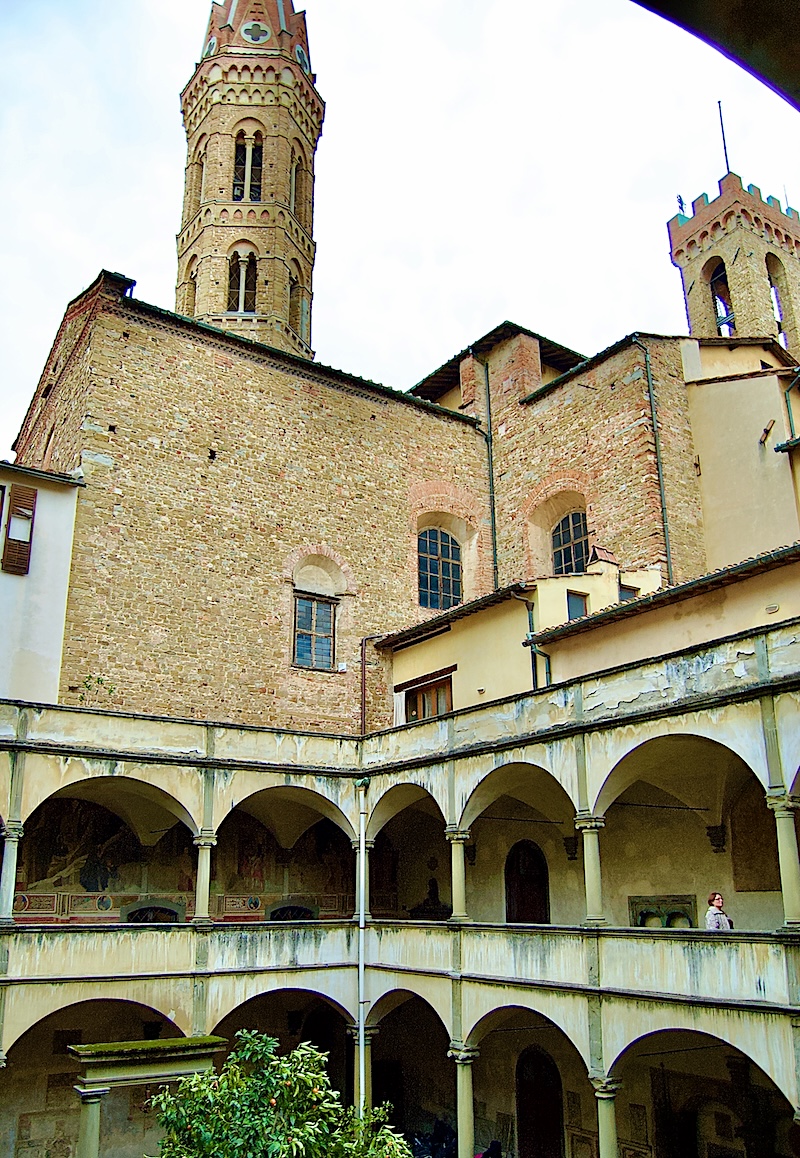
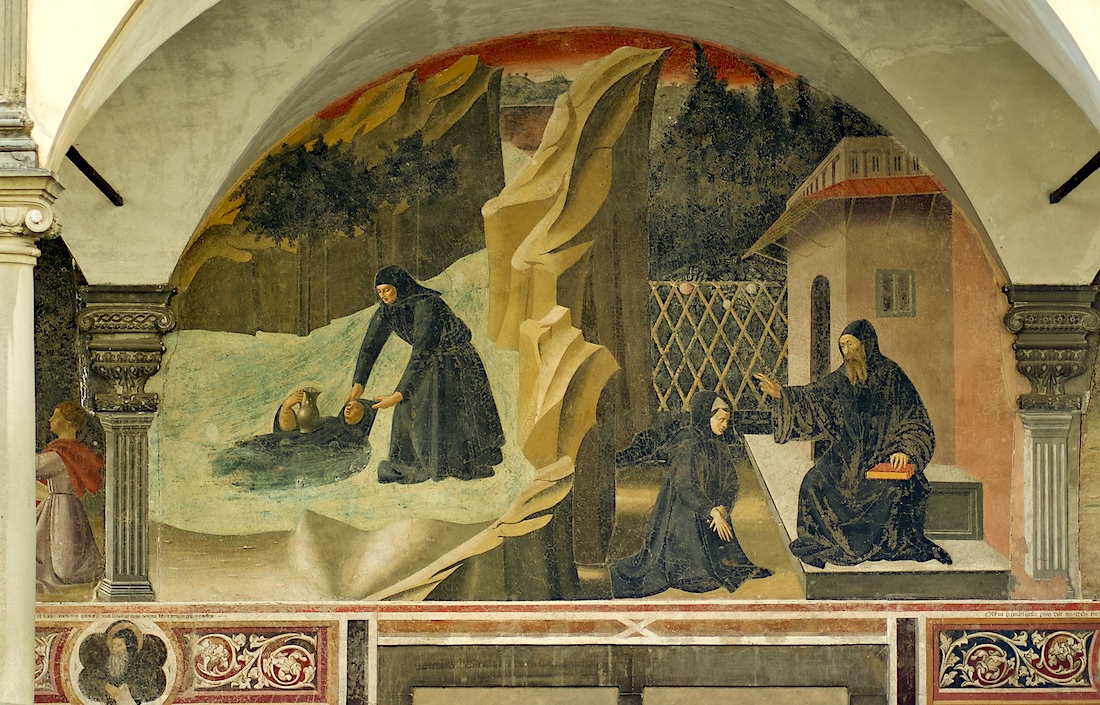
Built between 1432 and 1438 with Bernardo Rossellino, the Cloister of the Oranges (Chiostro degli Aranci) takes its name from an early, failed attempt to grow orange trees inside its walls. The upper-floor fresco cycle depicting the life of St. Benedict, painted around 1435-39, is usually attributed to the anonymous "Master of the Cloister of the Oranges," possibly the Portuguese painter Giovanni di Consalvo working in Fra Angelico's circle. One scene in the cycle was repainted by Bronzino in the 1520s. The cloister is only open during the Monday tourist-visit window - there is no other way in. The cloister's frescoes were most recently restored in 2018, timed to the 20th anniversary of the Fraternità Monastiche di Gerusalemme's arrival at the Badia in 1998.
Visiting
The Badia Fiorentina is a working monastery, home to the Monastic Communities of Jerusalem, and it runs on a liturgical schedule rather than standard museum hours. The one general tourist-visit window - covering both the church and the Cloister of the Oranges - is Monday, 3 to 5:30 p.m., with last entry at 5 p.m. Entry to the church is free; the cloister is €3.
Outside that window, the church is not open for casual sightseeing. It is, however, open to anyone who wants to attend a service: 7 a.m. Lauds, 12:30 p.m. midday prayer, and 6 p.m. Vespers followed by Mass, Tuesday through Friday; 8 a.m. Lauds, 12:30 p.m. midday prayer and Mass, and 6 p.m. First Vespers of Sunday on Saturday; and 8 a.m. Office, 11 a.m. Mass, and 6:30 p.m. Vespers on Sunday. Monday has no services at all - it's kept as a quiet day for the community, which is also why the community reserves it for visitors instead. The abbey is closed throughout August.
Dress modestly - shoulders and knees covered, no shorts or sandals - as at any Florentine church. The building is not wheelchair accessible; there are steps at both entrances. A small shop inside sells soaps and other goods made by the community.
Just across from the entrance (to the church, not the street entrances), a small shop called Monastica sells goods made by monastic communities from across Italy - honey, jams, wine, olive oil, liqueurs, and handmade soaps and lotions among them. It's staffed by two of the sisters from the Badia's own community, and since much of the stock is handmade in small batches at other monasteries, what's on the shelves can shift with the seasons. It's a low-key stop, but a nice one - and the proceeds support the monastic community that calls the Badia home.
A modern footnote
Dan Brown's novel Inferno opens at the Badia's bell tower, which has sent a wave of contemporary readers looking for the real building behind the fiction - only to find, most days, a quiet working monastery rather than a tourist site.
Badia Fiorentina FAQ:
What are the opening hours of the Badia Fiorentina?
The Badia Fiorentina's only general tourist-visit window is Monday afternoon, from 3 to 5:30 p.m., with last entry at 5 p.m. That same window is the only time the Cloister of the Oranges is open. On other days the church operates on a liturgical schedule rather than open sightseeing hours, and the abbey is closed throughout the month of August.
Is it free to enter the Badia Fiorentina?
Yes, entry to the church itself is free. There is a small charge to visit the Cloister of the Oranges, the abbey's 15th-century cloister on the upper floor.
How much does it cost to visit the Cloister of the Oranges?
Admission to the Cloister of the Oranges (Chiostro degli Aranci) is €3.00 per person. The cloister is only accessible during the Monday tourist-visit window, from 3 to 5:30 p.m.
Can the Badia Fiorentina be visited on Sundays?
The Badia Fiorentina does not offer general tourist visiting hours on Sunday. Visitors can attend Sunday Mass at 11 a.m. or Vespers at 6:30 p.m., but there is no sightseeing access outside of those services.
What is the most important artwork inside the Badia Fiorentina?
The Badia Fiorentina's best-known artwork is Filippino Lippi's "Apparition of the Virgin to St. Bernard," painted between 1482 and 1486. The church also holds sculptural work by Mino da Fiesole, including the marble Tomb of Ugo of Tuscany.
Is the Badia Fiorentina wheelchair accessible?
No. The Badia Fiorentina is not wheelchair accessible, due to steps at both of its entrances.
Why does the Badia Fiorentina appear in Dan Brown's Inferno?
Dan Brown's novel "Inferno" opens at the Badia Fiorentina's bell tower, drawing modern readers to seek out the abbey's real-world location on Via del Proconsolo, opposite the Bargello.
Hours
- Monday: 3-5:30 p.m. (only general visiting hours; includes the Cloister of the Oranges; last entry 5 p.m.)
- Tuesday-Sunday: not open for sightseeing - services only, see FAQ below
- Closed throughout August
Comments:
By Anthony Finta, last updated:
What's New?
-
Palazzo Vecchio Museum: Hours, Tickets, What to See
Sep 29, 2026
-
Sillico and the Garfangana
Sep 28, 2026
-

Tuscan Horticultural Society
Sep 20, 2026

-

Badia Fiorentina
Aug 31, 2026
-

Festa della Rificolona
Aug 30, 2026
-

Vinny's Florence Food Walking Tour
Aug 27, 2026
-

Corri la Vita 2026
Aug 27, 2026