Palazzo Vecchio Museum: Hours, Tickets, What to See
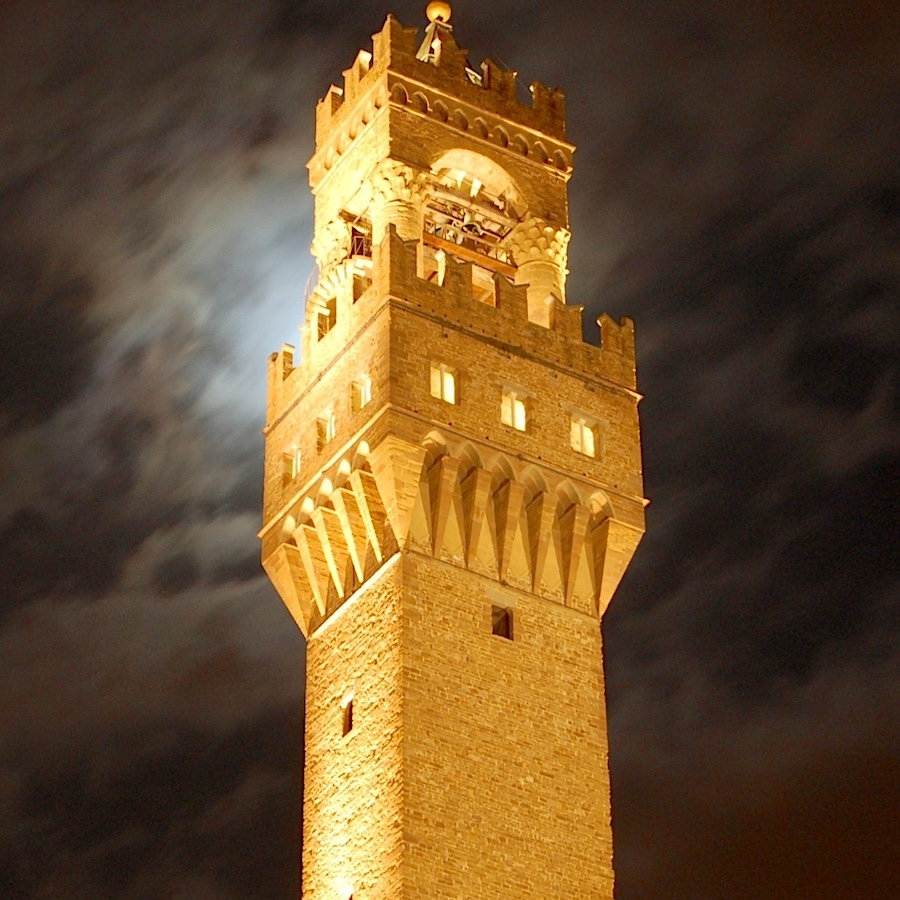
Palazzo Vecchio has been the seat of Florentine government for more than seven centuries, and it still is: the mayor's offices are inside, the city council sits here, and much of the building is a museum. It is the best single visit on the Piazza della Signoria - Medici apartments, Vasari's enormous Salone dei Cinquecento, a Roman theater underground, and a tower with one of the best views over the rooftops.
A Short History
Work began in 1299 on a palace for the city's supreme governing body, the Priori delle Arti and the Gonfaloniere di Giustizia, and the palace was known first as the Palazzo della Signoria. The soaring tower, about 95 meters high, belongs to that first core and is traditionally credited to Arnolfo di Cambio. Over the following centuries the building was extended and altered many times.
Its present look comes mainly from the mid-sixteenth century, when Cosimo I de' Medici moved his seat here in 1540 and had the interiors rebuilt and decorated, largely under Giorgio Vasari, to serve as a ducal palace. When the Medici court crossed the Arno to Palazzo Pitti, the building became the "old palace" - Palazzo Vecchio - although the piazza in front of it kept the name Signoria. The Guardaroba, which stored the family's ceremonial costumes and treasures, and various government offices stayed on. Florence was the capital of Italy from 1865 to 1871, and since the early 1870s the palace has housed the mayor's offices and the city council.
The Free Part: Cortile di Michelozzo
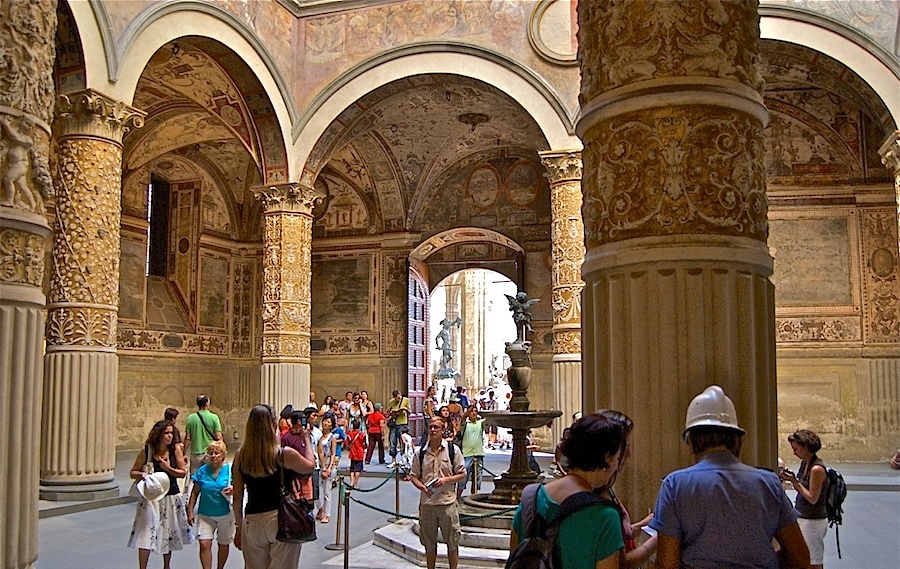
Do not skip the first courtyard, the Cortile di Michelozzo. You enter it from the main doorway on the Piazza della Signoria - the west side of the building, across from the Loggia dei Lanzi, where the copy of Michelangelo's David and Bandinelli's Hercules and Cacus stand guard. Entering the courtyard is free. It is decorated with stuccoes and gilt columns, and the walls carry views of Austrian cities that Vasari painted in 1565 for the wedding of Francesco I de' Medici and Joanna of Austria. In the center of the fountain is the Putto with Dolphin - a copy, since Verrocchio's original is upstairs in the museum.
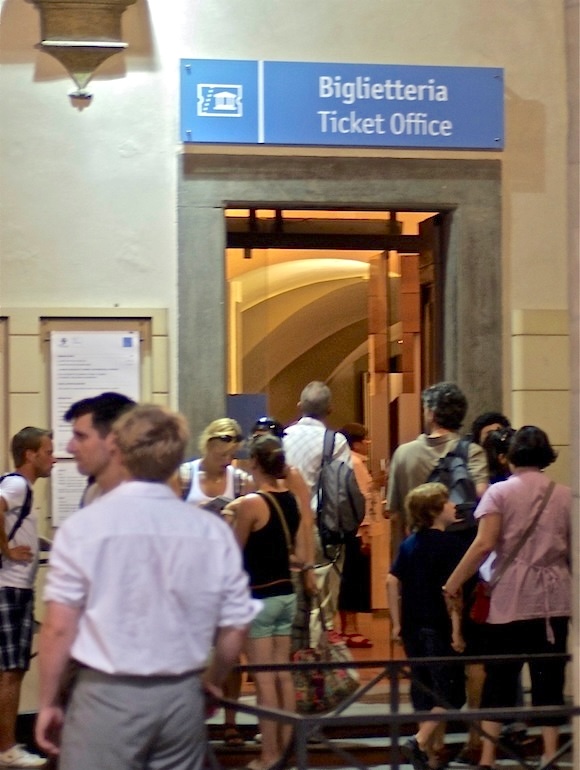
The museum ticket office is in the second courtyard, the Cortile della Dogana, a little further in. Expect a security check at the entrance. The ground-floor section called Tracce di Firenze, a short illustrated history of the city through works from the civic collections, is also free to visit during museum hours.
What to See Inside
First floor (the second floor, if you are American): Salone dei Cinquecento
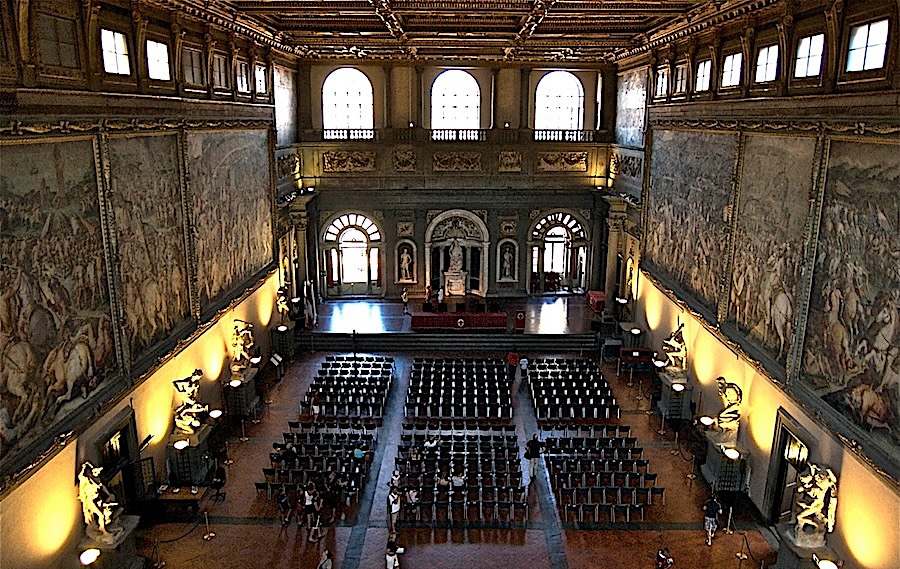
With a ticket you climb Vasari's monumental staircase to the Salone dei Cinquecento, the Hall of the Five Hundred, roughly 52 by 23 meters and still used for conferences, celebrations and government ceremonies. It was built in 1494 for the Republic's Great Council, then enlarged and redecorated by Vasari and his workshop as Cosimo I's showpiece. The ceiling of 39 panels and the huge wall frescoes celebrate the life of Cosimo and Florentine victories over Pisa and Siena, and the statues include Michelangelo's Genius of Victory. Off the hall is the Studiolo of Francesco I, a tiny, jewel-like study reserved for the grand duke and his closest guests.
This hall is also the setting for one of Florence's great art mysteries. Leonardo da Vinci began a mural of the Battle of Anghiari here in 1503, and Michelangelo was commissioned to paint the Battle of Cascina on the opposite wall; neither work is visible today, because the hall was remodeled by Vasari. A persistent legend holds that Vasari built a false wall in front of Leonardo's painting to protect it, and some scholars believe it is still hidden there. Searches so far have been inconclusive.
Mezzanine: the Loeser Collection
The mezzanine keeps more of the atmosphere of the medieval palace than any other floor. A collection of Medieval and Renaissance paintings and sculpture left to the city by the American collector Charles Loeser (donated in 1934) furnishes these rooms as an old Florentine noble house might have looked.
Second floor: the private apartments
Upstairs are the private rooms of the Medici court, all richly decorated and furnished. The Quartiere degli Elementi is the section built in the later sixteenth century, and the apartments of Eleonora of Toledo, Cosimo's duchess, include her Cappella di Eleonora, frescoed by Agnolo Bronzino. The oldest decorations in the palace survive in the Sala dell'Udienza and the Sala dei Gigli, where Donatello's original Judith and Holofernes is displayed - the statue you see outside on the piazza is a copy. Verrocchio's original Putto with Dolphin is also on this floor.
The Sala delle Carte Geografiche (the Guardaroba) is easy to walk past, and should not be missed: an exceptionally large globe and 53 surviving painted map panels by Egnazio Danti give a remarkable glimpse of the world as it was known in the sixteenth century.
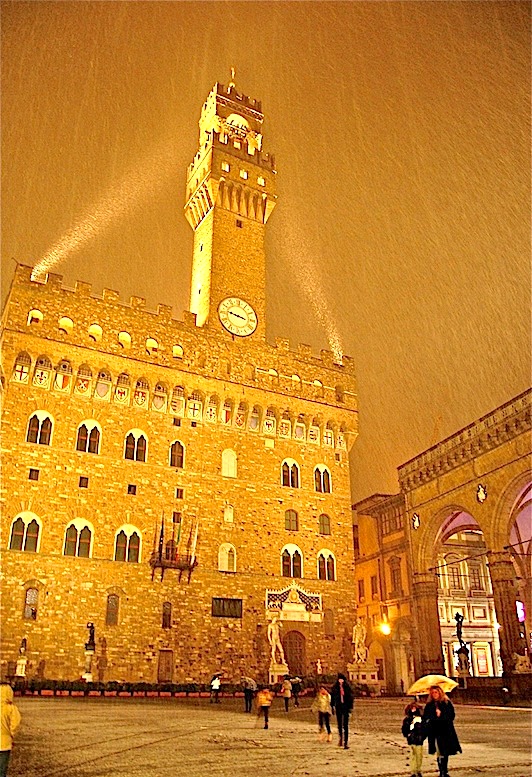
The Arnolfo Tower and the Walkway
The tower and the crenellated medieval walkway (the camminamento di ronda) are a separate site from the museum and need a separate ticket. A stone staircase of 223 steps leads up to the top, with views over the whole city. The tower is closed in rain, but the walkway stays open. Plan to arrive 15 minutes before your slot, and note that children under six are not admitted and anyone under 18 must be accompanied by an adult. After the climb, the nearby Orsanmichele and the Uffizi are a few minutes away on foot.
Practical Tips
- Thursday is the short day: the museum closes at 2 p.m., and the tower too.
- Last tickets are sold one hour before closing.
- Palazzo Vecchio is still a working city hall. Ceremonies can close the whole museum or single rooms, sometimes at short notice, and visits are restricted during heat alerts. Check the official site before you go.
- Book on the city's official ticket site, not a reseller - see our guide to official Florence museum websites.
- The Firenzecard (€85, 72 hours) is listed for Palazzo Vecchio with priority access; see our museums page for whether a pass suits your trip.
- Visitors with a backpack are asked to carry it in their hand through the museum.
- On weekends there are guided visits to the Roman theater excavations under the palace at noon and 12:45 p.m. (a €5 ticket, up to 15 people, booked in advance). Availability has varied, so confirm when you book.
For Florentine sculpture beyond these rooms, see where to see Renaissance sculpture in Florence.
Frequently Asked Questions
What are the opening hours of Palazzo Vecchio?
The museum is open Monday, Tuesday, Wednesday, Friday, Saturday and Sunday from 9 a.m. to 7 p.m., and on Thursday from 9 a.m. to 2 p.m. Tickets are sold until one hour before closing, and the museum is closed on December 25. The Arnolfo Tower is open from 9 a.m. to 5 p.m. on the same days, and until 2 p.m. on Thursday.
How much does a ticket to Palazzo Vecchio cost?
A full-price museum ticket costs €18 and a reduced ticket costs €12. Reduced tickets are for visitors aged 18 to 25 and university students. Visitors aged 17 and under enter free.
Do I need a separate ticket for the Arnolfo Tower?
Yes. The museum and the Arnolfo Tower are two separate sites with separate tickets, at €20 full price and €13 reduced for the tower. The tower is closed in rain, although the medieval walkway stays open, and children under six are not admitted.
Can I go into Palazzo Vecchio for free?
You can walk into the first courtyard, the Cortile di Michelozzo, without a ticket, and the Tracce di Firenze section on the ground floor is free to visit during museum hours. The rest of the museum needs a ticket, except for visitors under 18 and the other categories the city exempts.
Does the Firenzecard cover Palazzo Vecchio?
The city's Palazzo Vecchio ticket page lists the Firenzecard, which costs €85, is valid for 72 hours from first use, and gives priority access. That page does not say whether the Arnolfo Tower is covered.
Where is Donatello's Judith and Holofernes?
The original bronze is inside Palazzo Vecchio, in the Sala dei Gigli (Hall of Lilies). The statue standing outside on the Piazza della Signoria is a copy.
Is there a Leonardo da Vinci painting hidden behind Vasari's frescoes?
Nobody knows. Leonardo began a mural of the Battle of Anghiari in the Salone dei Cinquecento in 1503, and it disappeared from view when Vasari remodeled the hall. A legend says Vasari built a false wall to save it, but searches for it behind his fresco have so far been inconclusive.
Is Palazzo Vecchio wheelchair accessible?
Partly. Visitors with disabilities enter through the side entrance on Via dei Gondi. The two main floors of the museum are wheelchair accessible, but architectural barriers prevent access to the mezzanine.
Can Palazzo Vecchio be closed on the day I visit?
Yes. The palace is also the seat of the city council, so institutional ceremonies can close the museum or individual rooms, sometimes at short notice. The city also restricts visits during heat alerts, so check the official museum site before you go.
Palazzo Vecchio on the map:
Hours
- Monday: 9 a.m. - 7 p.m.
- Tuesday: 9 a.m. - 7 p.m.
- Wednesday: 9 a.m. - 7 p.m.
- Thursday: 9 a.m. - 2 p.m.
- Friday: 9 a.m. - 7 p.m.
- Saturday: 9 a.m. - 7 p.m.
- Sunday: 9 a.m. - 7 p.m.
Last tickets are sold one hour before closing. Arnolfo Tower: 9 a.m. - 5 p.m. (Thursday 9 a.m. - 2 p.m.). Closed December 25.
Comments:
By Anthony Finta, last updated:
What's New?
-
Palazzo Vecchio Museum: Hours, Tickets, What to See
Sep 29, 2026
-
Sillico and the Garfangana
Sep 28, 2026
-

Tuscan Horticultural Society
Sep 20, 2026

-

Badia Fiorentina
Aug 31, 2026
-

Festa della Rificolona
Aug 30, 2026
-

Vinny's Florence Food Walking Tour
Aug 27, 2026